Scoped settings
Session overrides beat project folders, which beat the surface (CLI, Desktop, IDE), global settings, the plugin tab, and the defaults. Anything unset inherits.
session › project › surface › global
Claude Code plugin / v0.5.2
Cache Warm sends one tiny keep-alive turn to idle Claude Code sessions before their prompt cache expires — so returning to a long context doesn't start with a full-price rewrite.
Works in the CLI, IDE extensions, and the Desktop app. Node 18+. Zero runtime dependencies.
Illustration. Values come from the shipped defaults and docs.
01 The cold return
Claude Code re-sends the whole conversation on every turn. The prompt cache makes that cheap — until the conversation sits still for longer than the cache TTL.
The cache expires after a period of silence: 5 minutes on an API key, 1 hour on a Claude subscription or with CLAUDE_CODE_PROMPT_CACHE_TTL=1h. The first turn after expiry re-writes everything at 1.25× (5m) or 2× (1h) input price — and it is slow.
Every cache hit resets the timer. One tiny turn shortly before expiry keeps a large context alive for a fraction of the rebuild. Cache Warm automates exactly that, and only when the session is genuinely idle.
one cache read of the whole context
one cache write of the whole context
List-price estimates from the plugin's own pricing table. One rebuild buys roughly 18 pings. On a subscription the same tokens come out of your usage limits.
02 How it works
The plugin is an ordinary Claude Code hook. At every turn end it starts a small sleeping process for that session. If the session is still idle one interval later, Claude Code wakes it with one line.
Stop hook · asyncRewake
A waker starts for this session and records Claude Code's own background_tasks and session_crons.
sleep until last request + interval
Any new request — you typing, an agent reporting back, a task firing — supersedes the sleeping waker. The next turn end starts a fresh one.
wake, re-check, decide
It re-checks background work, this session's scoped settings, the idle cap, the token floor, and whether the cache is still alive.
exit 2 → one turn → cache read
A one-line keep-alive note reaches the idle session. Claude replies ok; that turn reads the whole context from cache and resets the TTL.
It stands down when warming would not pay for itself.
maxIdleMinutes or the ping capminContextTokens cheap to rebuildclaude -p, Agent SDK03 What's in the box
Session overrides beat project folders, which beat the surface (CLI, Desktop, IDE), global settings, the plugin tab, and the defaults. Anything unset inherits.
session › project › surface › global
Warming state, next ping, context, cached tokens, remaining TTL, model, branch, PR, fill and limits. Your existing status line runs first and keeps its output.
one setting restores the originals
Every ping is judged from the transcript once its turn lands. A cache read is a hit; a rewrite is a miss. Two misses in a row suspend that session until you are active again.
/cache-warm:test proves the loop
Live sessions and countdowns, every scope's settings with inherited values, and analytics mined read-only from your own transcripts. Loopback only.
127.0.0.1:4777
A thin Tauri v2 tray for the global scope. Ctrl+Alt+W toggles warming; Ctrl+Alt+D opens the dashboard.
desktop/ · built with npm
Each session has its own waker and resolves its own settings. A Desktop session cannot change a CLI session by accident. Writes are locked and atomic.
no shared engine switch
04 The dashboard
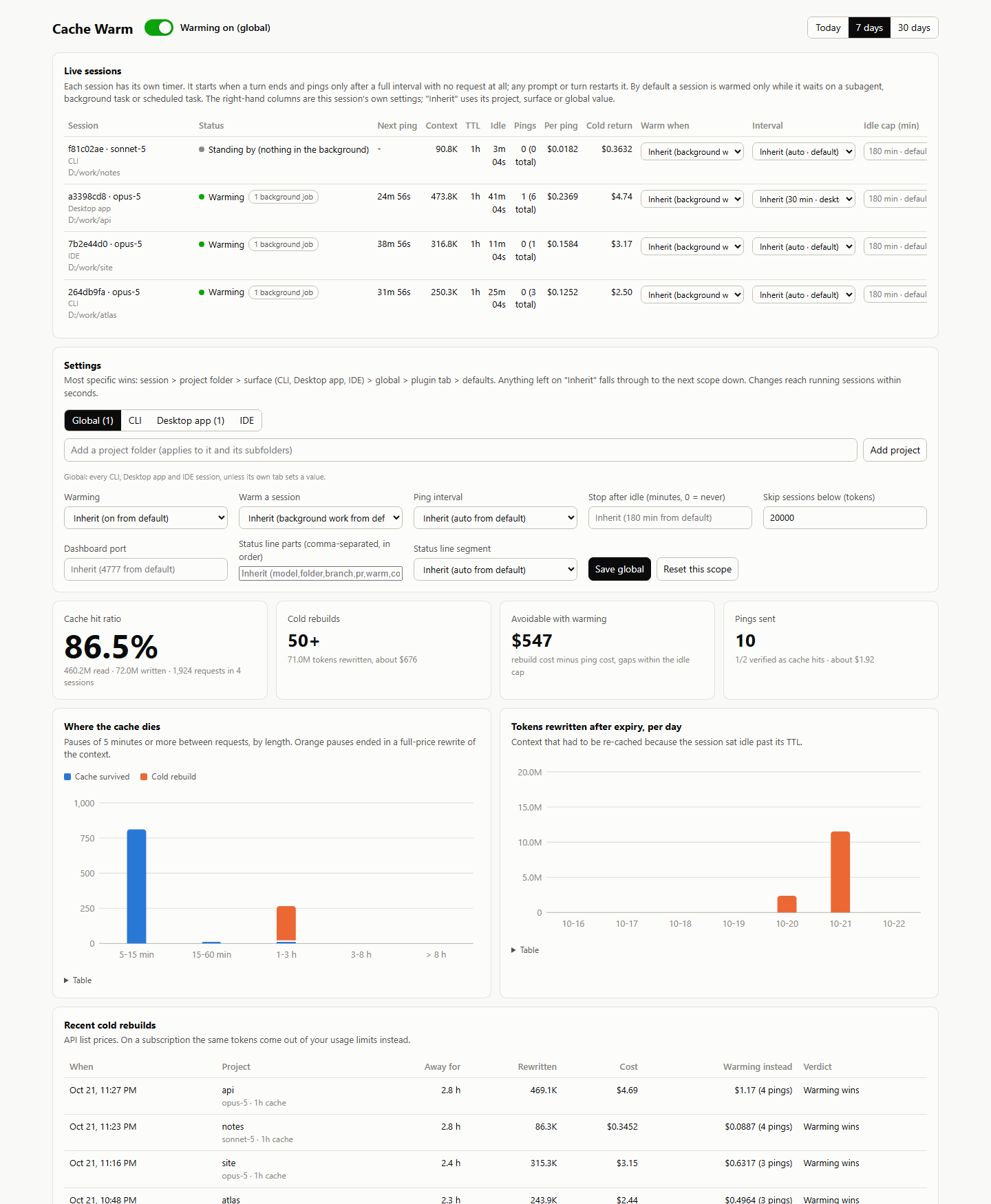
A real capture of the local dashboard with sample sessions. It binds to loopback, computes analytics read-only from ~/.claude/projects/**/*.jsonl, and edits every scope with “Inherit” showing what each field falls back to.
05 Configuration
Most sessions need no configuration at all. These values live in scripts/lib.mjs; this table is generated from them at build time.
| Setting | Default | What it does | Scopes |
|---|---|---|---|
enabled |
On | all scopes | |
warmWhen |
background-work | all scopes | |
intervalMinutes |
auto — 50 min on a 1h cache, 4 min on a 5m cache | all scopes | |
maxIdleMinutes |
180 min (0 = never) | all scopes | |
minContextTokens |
20,000 | all scopes |
Three more keys are global-only: statusline (auto), statuslineSegments (9 available parts), and dashboardPort (4777). Full reference →
06 Install
Cache Warm installs as a Claude Code plugin from its own marketplace. Nothing is downloaded from npm; the plugin has no runtime dependencies.
PATH
Claude Code recent enough for asyncRewake hooks
Inside Claude Code
/plugin marketplace add FiredMosquito831/claude-cache-warm
/plugin install cache-warm@claude-cache-warmThen, in each open session
/reload-pluginsDefaults: warming on, interval auto, only while a subagent, background task or scheduled task is pending. Verify with /cache-warm:status and /cache-warm:test.
07 Questions
Only if the pause is long enough and the context is big enough. The dashboard shows your real rebuilds and what warming would have cost instead. The FAQ covers cost, safety, subscriptions, and the cases where warming is deliberately skipped.
Read the FAQ